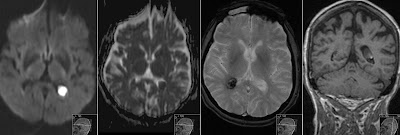
Chronic Subdural Hematoma - MRI Characteristics

Case: Chronic Subdural Hematoma (MRI Characteristics)
Imaging Modality: MRI Brain Sequences Provided: Axial T2, Axial FLAIR, Coronal FLAIR, Sagittal (with localization arrows)
Radiologic Findings: The MRI demonstrates a left-sided, crescentic extra-axial fluid collection overlying the cerebral convexity, measuring approximately 7.2 mm in maximum thickness.
A critical educational point is best appreciated on the initial axial T2-weighted image: note the medial displacement and compression of the underlying subarachnoid space. You can clearly visualize the small cortical veins situated at the inner margin of the fluid collection, right against the displaced cortex. This "cortical vein sign" confirms the fluid is entirely within the subdural space, pushing the arachnoid membrane and subarachnoid space inward.
When cross-referencing with the FLAIR sequences (axial, coronal, and sagittal), the collection does not suppress completely like normal cerebrospinal fluid (CSF). Instead, the fluid exhibits a distinctly increased, hyperintense signal. This incomplete suppression on FLAIR confirms that the fluid is not simple CSF (which would rule out a simple hygroma), but rather contains a high protein concentration. This proteinaceous fluid is the classic result of degraded blood products, characteristic of a chronic subdural hematoma.
Impression: Left-sided chronic subdural hematoma, demonstrating typical high-protein FLAIR hyperintensity and classic compression of the underlying subarachnoid space with medial displacement of cortical veins.
You may also review my previous posts:
Chronic Subdural Hematoma - MRI
You can also watch my video discussing this Chronic Subdural Hematoma on MRI